Anne Browne, a very wealthy woman

The Mansion, 21 Westgate
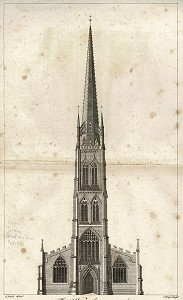
Buck's drawing
On a guided walk, Richard Gurnham pointed out to us the impressive house known as The Mansion at 21 Westgate and told us that this was the home of Anne Browne, who would have been the wealthiest person in Louth in the early 18th century. Further along he showed us another large house which Anne commissioned not long before she died in 1746.
Largely from Dr Gurnham’s book ‘The Story of Stuart and Georgian Louth’, I learnt more about Anne Browne. Born in 1671, Anne was one of two surviving daughters of George Saunderson, a gentleman who lived in Westgate. George’s large income came from the lands he owned and his other investments. He was warden of Louth in 1672-3 and again in 1687-8.
Anne was only 18 years old when her father died in 1689. A few years later she married Martin Browne whose ancestors had been prosperous farmers in Saltfleetby.
Martin and Anne remodelled the Saunderson family home in about 1704. It was probably the first large brick house in Louth, and its impressive design set the pattern for other 18th century houses in Westgate. The Mansion has seven bays of windows with a concave cornice over the centre. From an inventory, we know that it had three ground floor rooms: the Hall, the Great Parlour and the Drawing Room. Gurnham comments, “In the Drawing Room were two tea tables, a set of china and a walnut card table. Anne may well have been one of the first in the town to have drunk tea, for at the beginning of the century it was still extremely expensive.”
On their walls, Anne and Martin had portraits of King William and Queen Mary, showing that they were committed protestants and supporters of William III’s overthrow of the Catholic King James II. Anne commissioned Samuel Buck to make an engraving of St James’ Church, viewed from Westgate. This drawing, dating from 1725, is the earliest known picture of the church.
Martin Browne died in 1716, but Anne continued to reside in The Mansion. She outlived all her children, and in her later years she lived there with her son-in-law Robert Cracroft and his two daughters. Robert was warden of Louth in 1735-6 and twice later.
In 1745 when she was an old lady, Anne Browne built a house as an investment for her granddaughters. This is known as Arnold House and is now 45 Westgate. Its general style is remarkably like The Mansion, but it has only five bays, not seven.
The early 18th century was a time when there were massive class distinctions in wealth and social standing within the community. At this time, it was generally the men who owned the wealth. Anne was rich because she was born into a wealthy family, she married a wealthy man, and she inherited his fortune.