Louisa and William Minkley
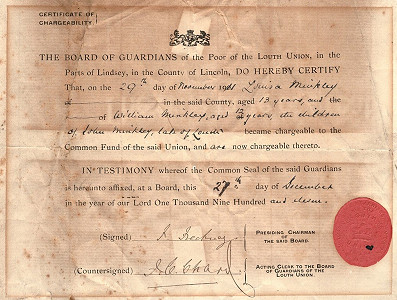
Certificate of Chargeability
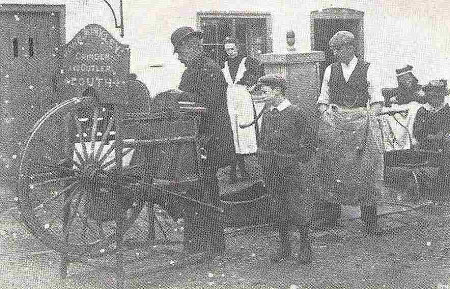
John Minkley. Credit Lincolnshire Life
Two rather faded documents relate to Louisa and William Minkley, whose parents had abandoned them. The children were 13 and 12 years old, and the date was 27 December 1911, two days after Christmas. The first is a “Certificate of Chargeability” issued by the Guardians of the Poor, stating that the children were to be looked after by Louth Union Workhouse. The second is a warrant for the arrest of their father, John Minkley, who travelled around the town and villages, sharpening knives and scissors. The photo shows him with his trolley, “John Minkley, Grinder & Cutler of Louth”.
I wanted to find out more about the family, to discover why these children were homeless, and what happened to them afterwards. By 1911, John Minkley and his wife Sarah had eight children. Louisa and William were two of the younger ones. They had been living in Kiln Yard on the southern side of Queen Street, and then moved to Spring Gardens, a little further west. Both these areas were overcrowded with poorly built cottages and featured unfavourably in newspaper reports. In 1901, there had been a complaint against Sarah for using obscene language.
The stresses in the Minkley family must have been overwhelming, and they split up. Sarah moved Grimsby, where she got a job as a bag cleaner in a jam factory. John briefly lived in Spittal Hill, off South Street, and then he disappeared. Three of the older boys set up a household in Batty’s Row, now the location of the Salvation Army building in Queen Street, and they all worked as hawkers selling goods in the streets. It appears that Louisa and William were not welcome as permanent residents in any of these homes – so damaging for them physically and psychologically.
Louisa had been attending St Michael’s School in Church Street but when she entered the workhouse she transferred to the Girls' School in Broadbank where she remained until July 1912. Now at an age where she could start work, she went to live with her mother in Grimsby. When she was 19, she married a fisherman, Jonah Tomlinson. They had four surviving children, but Jonah became unwell and not able to work. Louisa continued to live in Grimsby, until her death at the age of 80.
William remained in Louth workhouse after Louisa departed. He and another boy absconded twice. The first time they went to Grimsby to his mother, but she refused to take them in. The second time they went along the Spilsby road but got only as far as Burwell. At the beginning of World War I, William enlisted in the Royal Navy, joining as a boy not quite 16 years old. The records show that when he was 18, he was still only a little lad - 4 ft 10 inches in height, 31-inch chest, light brown hair and blue eyes. In 1919 William left the navy and joined the 5th Battalion of the Lincolnshire Regiment which was stationed at the former Royal Naval Air Station in Killingholme during the 1921 coal strike. William married in 1924, but he and his wife had an unhappy abusive relationship and after three months she left him. Later that year he attempted suicide. He worked in the fishing industry in Grimsby.
Are you wondering what happened to John Minkley? It appears that the authorities in Louth did not manage to catch up with him to make him pay his dues. To remain hidden, he could no longer go around with his trolley proclaiming his name and profession, so he returned to his roots in Nottinghamshire, where he lived with a common-law wife, working as a railway platelayer (1921) and a general labourer (1939).