Dairy farming in the last 100 years
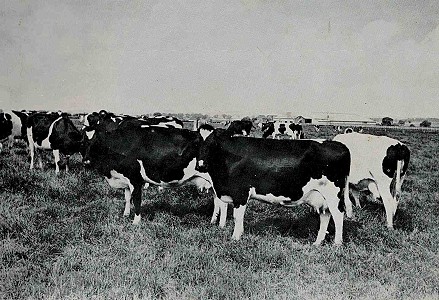
Cockerington herd sold in 1971
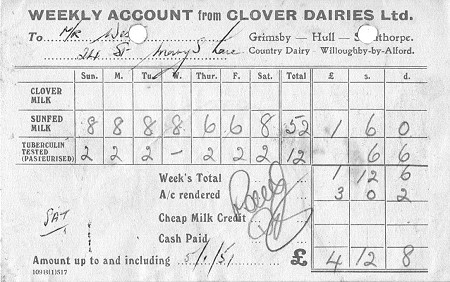
Invoice for milk
Various documents in the museum collection have inspired me to examine developments in dairy farming. The number of dairy farms in Britain has declined dramatically over the last century, with a move towards larger herds. In the 1950s there were nearly 200 thousand dairy farmers, but now there are only about 7 thousand. The average herd size in Britain is currently about 220 cows, and rising.
The change has taken place principally because it is more efficient to produce milk in large units, which need little labour input. Modern dairy farms use technologies such as computerised recording of herd information, automatic feeding of individual animals, and even robotic milking machines which allow cows to choose when they want to be milked.
In the first half of the 20th century, many of the farms in the Louth area were mixed farms keeping sheep, pigs and dairy cows as well as growing a variety of crops. This diversity was advantageous because it spread the risk of failure of one enterprise, and it spread the labour requirements.
At the beginning of the 20th century, liquid milk was the single most important product from British farms. Particularly during the war years, the nutritional importance of milk for children was recognised. The Milk Marketing Board was established in 1933 (and abolished in 1994). It controlled milk production and distribution in the UK, and it guaranteed a minimum price for milk producers. Until the 1960s, milk was collected in metal churns from the farm gate and taken to a dairy factory where it was pasteurised and bottled. Gradually churns on a lorry were replaced by a milk tanker. From the dairy factory milk was distributed in reusable glass bottles to your doorstep by the milkman.
The invoice shown here was for milk supplied in 1951 by Clover Dairies of Willoughby (near Alford) to The Cedars, a large house in St Mary’s Lane, home of Theodore West and family. Note that milk was delivered every day of the week, including Sunday.
Nowadays, most of us buy our milk in plastic bottles from a supermarket. This lacks the personal touch but it is efficient, and because the standard of hygiene is excellent and the milk is refrigerated, the shelf-life of an unopened refrigerated bottle is about two weeks.
In Lincolnshire the decline in dairying has been particularly dramatic, and there are no dairy farms near Louth today. Milk production has largely moved to areas such as Devon and Cumbria. This is because on the western side of the UK the climate is favourable to grass growth with a less severe winter and fewer droughts in the summer months. Also, in Lincolnshire farmers have more options for other types of farming, such as growing cereals and vegetables. It was often distressing for farmers to realise that their dairy enterprise had become financially unsustainable and they needed to sell their cows.
In the museum we have the sales details for local dairy herds which highlight the changes in the structure of the dairy industry. For example, in 1951, Mr J T Dickerson of Eastfield Farm, Stewton gave up dairying. His small herd, typical of the time, consisted of eleven cows and some younger animals. Each cow had a name: Primrose, Panda, Buttercup, etc.
Mr Dickerson’s cows had milk yields which at the time were considered good, averaging about 4,000 litres per cow per year. Today, 2026, average milk yield is much higher, about 8,400 litres.
With this increase in efficiency of production, the price of milk (in real terms) has come down, and I find it amazing that today milk, with all its nourishment, can be bought for only about 75p per litre, not much more expensive than bottled drinking water.