Urban dairies in Victorian times
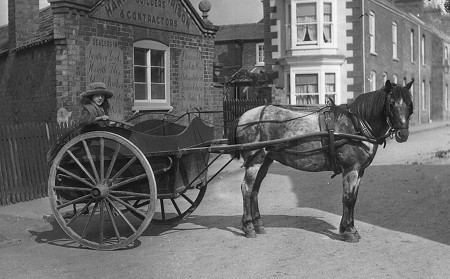
Milk delivery in Louth, early 20th century
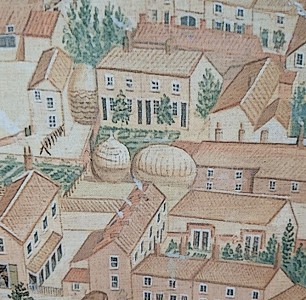
Stacks of hay and straw in the town
The previous blog post on milk production in the 20th century, prompted me to look at Victorian dairy systems. Before refrigeration, it was beneficial to have milk production located close to consumers. Milk is a perishable product, and particularly in the summer months, it quickly turns sour. Therefore, almost immediately after the cows were milked, their milk had to be distributed to consumers.
The Victorian censuses and local directories tell us that there were several milk producers with their very small herds actually in the town of Louth, so they could supply milk directly to their customers. The ten cowkeepers listed in the 1872 directory are:
- George Clark, Newmarket
- George E Cotten, 45 James Street
- William Enderby, Gray’s Road
- William Fowler, Union Street
- Edward Johnson, 73 Walkergate [now Queen Street]
- William Melbourne, Riverhead
- John Sowter, Monksdyke Side
- Julien Surfleet, Crowtree Lane
- Edward Wells, 37 Enginegate [now Broadbank]
- John Willows, Brackenborough Road.
For some of these, such as William Enderby and Edward Wells in the Broadbank area, dairying was their main business and for several decades they specialised in milk production. For others, milk production was a sideline. For example, cowkeeper George Cotten was principally a shoemaker. John Sowter was a brickmaker’s labourer who became a cow keeper, and later he was a grocer. John Willows in Brackenborough Road, on the outskirts of the town, was also described as a cottager, or as we would say now, a smallholder.
The people in this list are all men. However, almost certainly their wives and other female members of the household would have been heavily involved with the feeding, general care and milking of the cows, and the selling of milk.
Although someone who sold milk from just one cow could be described as a cowkeeper, most urban cowkeepers would have had at least two or three cows to ensure continuity of milk supply. Cows produce lots of milk after they have calved, but production then declines, and almost always a cow becomes “dry” before she calves again. It was best to have cows which calved at different times of the year.
Many readers will be familiar with the Louth Panorama, a picture of the town painted by William Brown in 1844, looking down from the spire of the church. He did not show any cows in the town, nor in the fields. Some people might say that William Brown was simply not interested in cows, but it is more likely the cows were all housed in sheds. He, however, did record stacks of hay and straw throughout the town and these would have been the feed and bedding for the cows as well as for the horses that were stabled there.
You can imagine that without due care and attention, the keeping of cows in close proximity to people could become a health hazard. Just think of the dung and urine produced. Dairy hygiene was a matter for national concern, and received due attention from the government. The “Dairies, Cowsheds and Milkshops Order” of 1885 required that all cowkeepers must be registered, and their premises inspected in order to protect the public from diseases associated with milk.
In the museum we have a booklet written and distributed by the Borough of Louth in 1899 that states the local bylaws relating to milk production, including detailed requirements for the lighting, ventilation, cleanliness, drainage and water supply in cowsheds. All vessels used for milk had to be cleaned and sterilised with boiling water. The cows’ udders and teats had to be washed before milking. The penalty for not following the regulations was £5, with a further £2 per day if the offence continued. These regulations, together with developments such as pasteurisation and refrigeration, led to the demise of urban dairying.