St Mary’s Church, Louth
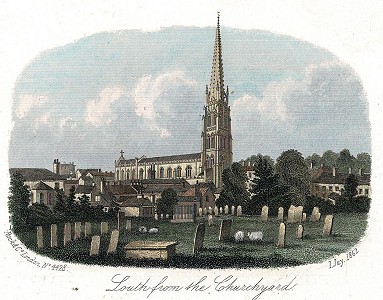
St Mary’s Cemetery, 1862
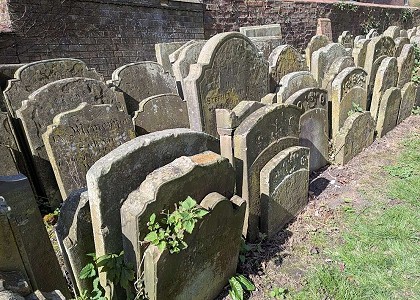
Gravestones around perimeter
In 1909, Richard Goulding, a respected historian and a member of the Ants & Nats, gave a lecture on the topic of St Mary’s Church in Louth. This was not our current St Mary’s Catholic Church in Upgate, built in the 1830s, but a much older one. The information given here is taken from Goulding’s lecture and from Richard Gurnham’s 2024 book “Louth History Around Us, Vol 3”.
Goulding began by telling his audience that the history of the Church of St Mary, is a tale of vicissitude, decay and destruction. First, it was a church, next a school, then an almshouse, and finally a barn, liable to be used as an isolation hospital.
St Mary’s Church was first mentioned in 1267, but it may have been built long before this, and the first church building may have been preceded by a simple preaching cross.
The church building must have been within the enclosure of St Mary's Churchyard on the higher ground on the northwestern side of the town. We now call this area the “Old Cem” because it was the town’s cemetery. No visible traces of the church building remain, and its exact site has been forgotten.
Gurnham speculates that the existence of a church here suggests that there might have been a small medieval suburb on this side of the river, probably on Cisterngate.
When the church was closed, following the Chantries Act of 1547, it was a substantial building, with three altars, and a tower with three bells. The windows of the church were walled up, and the bells taken down and sold. Permission was granted for the empty church to be used by the grammar school. This was however a short-lived arrangement, because of its “extreme bleakness in wintertime”, and the school moved into rooms over St Mary’s Bedehouse in Schoolhouse Lane.
The church building was then used as a poor house and a plague house, before being taken down and disappearing completely in the 18th century, but its graveyard became the principal parish cemetery. Stonework thought to be from the old church, has been found in the garden of the house known as Saint Mary's Mount, immediately to the east of the cemetery.
Originally the parish cemetery had been on the north and south sides of St James' Church but during the 18th century it became too full, and St Mary's cemetery was used instead. Although St Mary's graveyard had been consecrated in 1500 it seems to have been little used until 1770. The burial ground was enlarged in 1827, but even after that there were reports that it was impossible to dig a grave without disturbing earlier burials.
In 1840, General Loft described St Mary’s Burying Ground as being fenced on the west side by hawthorn hedges, on the north, east and south sides partly by a hedge and partly by paling. The carriage entrance was by folding wood gates in the southeast corner, whence there was a gravel road for foot passengers to the northwest corner. General Loft also made a list in 1836 of all the inscriptions on the gravestones.
From 1855, burials took place in the new London Road cemetery, and the only burials in St Mary’s were for those who had already purchased a burial site; the last burial here was in June 1890.
A couple of years after burials were transferred to London Road, the vicar described the old cemetery as a place of desolation and ruin that he wanted to beautify and adorn. Mischievous boys played pranks among the headstones and damaged them. Because it was difficult to mow the grass between the headstones, sheep were grazed there in the summer.
In 1934, the gravestones were moved to the edges of the cemetery, and consequently most inscriptions can no longer be read. Thankfully, we have a copy of General Loft’s 1836 transcriptions.