Bomb Damage in World War II
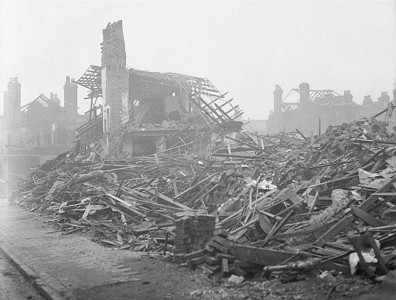
Bomb damage in Birmingham
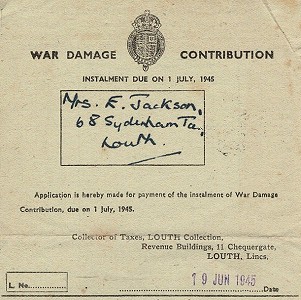
War Damage Contribution
Currently in Louth Museum, there is a thought-provoking exhibition, “Waging Peace in Lincolnshire”. As a reminder of the brutality of war, this blog post takes a look at bombings in World War II, and the consequences.
The internet tells us that World War II bombing in Britain resulted in approximately a million houses destroyed or damaged. Hull suffered gravely, with 95% of its houses wrecked.
To reduce the chance of night-time bombing, everyone was required to cover windows using heavy curtains, cardboard, or black paint. This was known as Blackout. Streetlights were switched off, vehicle headlights fitted with slotted masks, and Air Raid Wardens strictly enforced the rules.
Compared with other towns and cities in Britain, Louth was subject to relatively little bomb damage. In December 1945, the Police Constabulary produced a booklet that summarised details of the bombs dropped and the losses of lives and property in Lincolnshire during World War II, and this tells us that there were three bombing incidents in the town of Louth, and some more in the surrounding area.
During the early evening of 5 December 1940, incendiary bombs were dropped near Louth Railway Station and were quickly dealt with. Unfortunately, another had fallen unobserved on the large malt kiln next to the station, which caught fire and burned all night, illuminating the sky for miles around. Fire Brigade reinforcements were obtained from Grimsby, but the fire was not extinguished until daylight. In the museum collection we have the telegram that the manager, Mr Sandars, sent to his HQ: “Soanes Number One Malt Kiln Destroyed by Enemy Action. Walls only standing. Stock destroyed.”
On 19 February 1941, eight people were killed by a bomb in Ramsgate, and on 7 September 1941, a bomb on the Grimsby Road resulted in the death of seven people, mostly members of the Jaines family. Mrs Margaret Ottaway was one of the survivors of that traumatic incident.
We have been given documents dated 1943 and 1945 which record War Damage payments made by Mrs Elizabeth Jackson of Sydenham Terrace, Louth. These payments were part of a compulsory insurance scheme in Britain which was introduced in 1941 and continued for five years. In addition to paying income tax, property owners had to pay to the War Damage Commission an annual contribution based on the market value of their property. In 1945, Mrs Jackson paid £3 10s 6d.
Thus, the cost of repairing bomb damage was shared between property owners throughout the country. Claimants received funding once they had undertaken restoration work, and so owners of damaged buildings were incentivised to restore them, rather than leaving them derelict. This approach addressed immediate housing and commercial shortages, allowing economic activities to resume in urban areas devastated by aerial bombardment. The War Damage Commission was, however, criticised for its slow and inefficient bureaucracy.
World-wide the cost of restoring physical property and bomb damage during World War II has been estimated to be about $3 trillion. In the UK it was about £1.45 billion. There were around 60,000 civilian deaths in the UK, and the impact on the mental health of the civilian population was immeasurable. Surely, we ought to have better ways of solving problems rather than going to war.
In response to this blog, David Clark pointed us to a video he produced in 2006 which is available on YouTube: 'Louth Lincs. The Grimsby Rd Bombing, Sept 7 1941'. Thank you, David.