Alfred Ticklepenny of Keddington
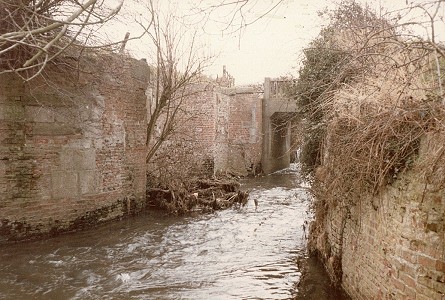
Ticklepenny Lock
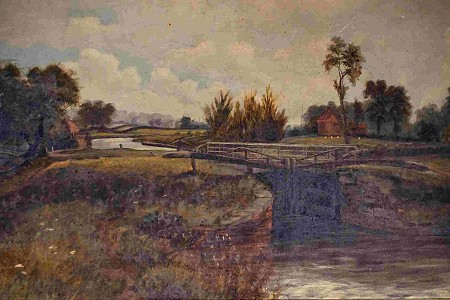
Painting by Bennett Hubbard
We have been cataloguing the burial records for St Margaret’s Church in Keddington. The name Ticklepenny or Tickelpenny appears a number of times. The Ticklepennys had a farm in Keddington, and when the canal was built it cut straight through their land so that was how the name of Ticklepenny Lock originated. The four locks near Louth, listed from west to east, are Top Lock, Keddington Lock, Ticklepenny Lock and Willows Lock.
Alfred Ticklepenny who died in 1885, was the son Thomas Ticklepenny, who was both farmer and lock-keeper. Alfred and his wife Esther (they married in 1846) lived in Cowslip Lane, Keddington. Alfred was a smallholder but also worked as an agricultural labourer.
Alfred eventually became the collector for tolls on Louth Canal, and worked in the Commissioner’s Office in Louth Riverhead. There were a number of tragedies on the Keddington stretch of the canal in Alfred’s lifetime, and inevitably he became involved and took part in the inquests.
In April 1869, when James Davey (23), a mate on the sloop the Hawk, was opening the gates at Willows Lock, the handle slipped and he fell in. He was dashed against the side and sank into deep water. Half an hour later his body was recovered by Alfred and other labourers.
Another young lad who died was George Brogden (17). On a Tuesday morning in 1871, Alfred Ticklepenny was walking along the canal bank towards the Riverhead when he found a stick with a hat beside it. He couldn’t see anything in the canal so he continued on his way. He mentioned his observations to a fellow worker and they returned together and found George Brogden’s body outside the lock. A verdict of found drowned was returned. George was the son of Louth printer Frederick W Brogden and his wife Matilda.
Mrs Betsy Carritt (51), a farmer’s wife, was found in the canal in September 1877. The jury went to the deceased’s house near Willows Lock to view the body and then to the canal where she had perished. Mr Carritt said that on Saturday evening his wife had set off for Louth to buy some bread. When she didn’t return Mr Carritt went to look for her, and a passerby said he had heard a woman screaming. Alfred Ticklepenny was fetched and, using his drag, the body was discovered. She had bought two loaves of bread, but only one was found with the body. Mr Carritt said his wife was short sighted and something must have frightened her. With the lack of evidence as to how she got into the canal, a verdict of found drowned was returned.
One Sunday morning in September 1880, Mr Thomas Swaby (31), unmarried, was found in Ticklepenny Lock. Dr Sharpley, the coroner, held the inquest at Alfred Ticklepenny’s house. Thomas who had been living with his father George Swaby, a master tailor in Eastgate, was described as a loner, and irritable and excitable when he had had a drink. A verdict of suicide while temporarily insane was returned.
The sad case of Mrs Elizabeth Alcock (37) occurred in 1879. Mr Sanderson was tending his garden when a woman walked past heading for Keddington Lock and after a moment, he observed her jumping into the canal. He ran to the spot with a rake but was unable to retrieve her so he fetched Alfred Ticklepenny with his drag, and after 90 minutes the body was recovered. Mrs Alcock’s husband, a bricklayer, was known to like a drink and she was unable to perform her cleaning job because of this. A verdict of suicide through mental derangement was returned. She left a family of five children, the youngest only 4 years old.