Mail coach Louth to London
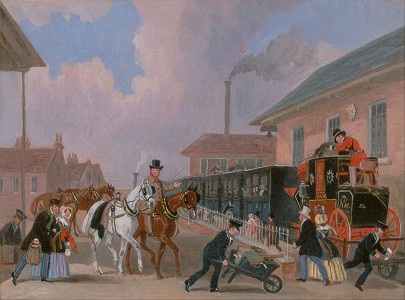
Coach on the train at Peterborough. J Pollard
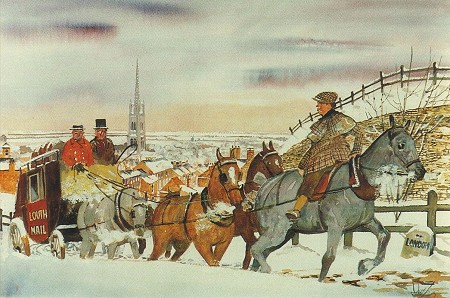
Mail coach departing in snow. D Cuppleditch
An email from Helen Dunning led us to look in more detail at the Royal Mail coach service between Louth and London, which operated in the first half of the 19th century. The Post Office in London had started using stagecoaches in the 1780s to transfer mail between cities and towns in England. These four-wheeled coaches, which changed their horses at regular points, replaced much slower services. For example, before Louth got a stagecoach service, the 1792 directory tells us that a waggon set out from Louth’s Blue Stone Inn every Saturday at 3 am, and arrived one week later in Basinghall Street, London.
The developments in mail services came about for various reasons: improvements in roads, superior design of coaches, and economic pressures resulting from the industrial revolution.
The first Royal Mail route between Louth and London included a transfer in Lincoln. According to Richard Gurnham’s book, “Not Particularly Sober”, a direct Royal Mail service began in 1807. This new route was via Boston, and in 1815 it operated three days each week and took 12 hours to get from Boston to London.
By 1822, there were two coach services between Louth and London every day. The coach via Boston and Spilsby arrived at Louth at 7 pm, and departed the next morning at 4 am; and the Lincoln coach arrived at 9 pm and left the following 2 pm.
The horses and coachmen were organised and employed by the landlords of the coaching inns, but the vehicles and armed guards were provided by Royal Mail. The Louth-based coach operators were the King’s Head in Mercer Row, the Mason’s Arms in the Cornmarket and The Fleece in Mercer Row.
Louth’s first Post Office was on the corner of Eastgate and Vickers Lane, and the 1826 Directory tells us that six days each week the Louth Mail arrived at 4 pm, and was despatched at 11 am. Further mail coaches ran between Louth and other towns in the region.
The mail coaches were expensive elite services, with a guard in smart red uniform who had a top hat. He carried a gun for protection, and a long horn to announce the arrival of the mail. The mail coaches carried passengers, at a price.
William Charles Rhodes of Boston was a guard on the Louth mail coach. One winter in the 1830s, he was working on the London to Louth coach when the road between Spilsby and Louth was blocked by snow. Eventually a pathway was dug to the coach, and Rhodes carried the mail bags on horseback for the remainder of the journey to Louth. For him, the safe transit of the mail was more important than the safety of passengers!
The expansion of the railways greatly affected the coach services. From 1845, when the Peterborough-London railway opened, the Louth mail coach could board the train in Peterborough. Then the railway was extended to Lincoln, and after 1848 when Louth Railway Station opened the Louth-London mail coach was no longer needed.