Rocket House in Saltfleet
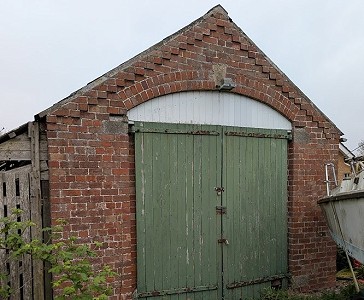
Saltfleet Rocket House, May 2026
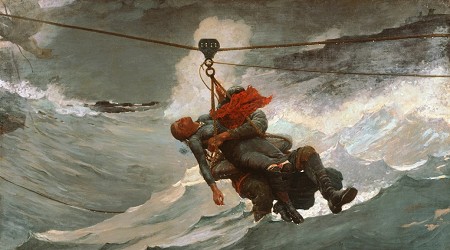
The Life Line, by Winslow Homer
While working through our backlog of items, we came across a notice for the 1951 sale of a building in Saltfleet known as The Rocket House. Saltfleet is a village on the Lincolnshire coast to the east of Louth.
Searching in local directories, old newspapers and online, we found that the Saltfleet Rocket House was associated with the coastguard station, and housed their life-saving rocket apparatus. The former Rocket House can still be seen on the western side of the main road, north of the four coastguard cottages.
In the 19th century, the rocket apparatus became a vital part of seafaring rescues. It was mounted on a cart so it could be wheeled to a location close to the ship in distress. A thin rope was fired out to the ship, and this would allow the ship’s crew to pull in a strong thick rope. Then, using a zip line the shipwrecked mariners could be winched safely to shore in a breeches buoy life ring, a round flotation device with leg harness attached.
The idea of helping a sinking ship by throwing a rope over it, is attributed to Captain George William Manby, on witnessing a shipwreck off Yarmouth in 1807. In 1825, Captain Manby was given a Gold Medal by the RNLI, and his apparatus was exhibited at the 1851 Great Exhibition in London.
The Board of Trade took over the management of all UK rocket apparatus in 1857, and to ensure that everyone knew what to do in an emergency, instruction cards were issued to all ships and these had to be displayed prominently. Merchant marine officers were required to understand the working of the apparatus. It is recorded that more than 173,000 lives were saved from shipwrecks off the UK coast between 1856 and 1909, and of these 17,446 involved the use of rocket fired lines.
Saltfleet received their rocket apparatus in 1866. The censuses show that by 1871 the coastguard cottages had been built and four coastguard officers lived there. Every three months, a practice rescue was undertaken. Many volunteers assisted. One report states that the number of personnel involved in the Saltfleet Lifesaving Rocket Brigade was 17.
There are numerous newspaper reports of the Saltfleet rocket being used to save lives. The Saltfleet residents were obviously proud of the efficiency of their lifesaving brigade. For example, when the SS Mourne, a coastal steamer, ran into difficulties during a storm in November 1927, its crew of seven were successfully rescued. On this occasion, Mr J W Jacklin [John William Jacklin, a builder who became the landlord of the New Inn] placed a line across the ship in less than five minutes, which they thought was a British record.
Lifeboat and rocket stations had been established at strategic locations around the coast, often just a few miles apart, where sailing vessels were known to have been driven ashore in poor conditions. But in the 20th century motor-powered lifeboats were introduced which were fast and could travel farther.
So, in 1929 it was decided to close Saltfleet coastguard station. Mr Ernest Beard, the Chief Coastguard Officer was transferred to Donna Nook near North Somercotes. The rocket apparatus remained in Saltfleet, and until at least 1937 it was manned by volunteers. The coastguard cottages were rented out.
Shortly after World War II the four coastguard cottages were sold. In 1951, the rocket house itself was sold for £140, to someone who used it as a garage. A few years later it was purchased by the County Council as a road maintenance depot.