Signposts
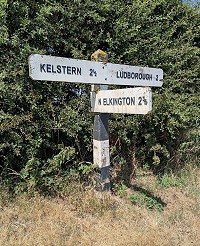
Traditional signpost
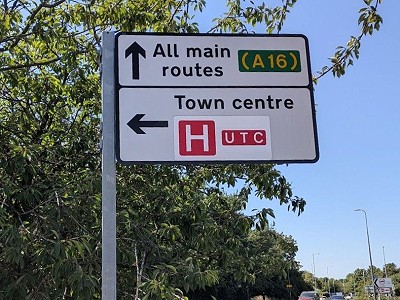
Modern signpost
A recent talk by Dr Barry Barton stimulated my interest in the history and development of signposts on public highways. Almost 2,000 years ago, the Romans had milestones along their major routes in Britain. Two are preserved in Lincoln Museum.
In 1696, the Highways Act was the first piece of UK legislation to mandate the siting of direction stones or posts at road junctions. In the next century milestones were compulsory on all turnpike (i.e. major) roads. One milestone still in its original location can be seen on the southern side of the former Dexthorpe Turnpike, now A631, between North Willingham and Ludford, grid reference TF180886.
County Councils were established in 1889 and became responsible for the maintenance of main roads and signage. After World War I the Ministry of Transport was formed, and in 1923 roads were categorised into classes A, B, C and minor roads. Early county council signposts were tall with small uppercase lettering, almost impossible to read when travelling at speed. The problem was even worse when unnecessary information was included, for example stating distance as 4 miles 3 furlongs!
Early 20th-century signposts were made of various materials: uprights of concrete, cast iron or wood; and arms of wood or metal. Each Council adopted its own style of post, with distinctively shaped uprights and arms, and usually a finial at the top.
At the outbreak of World War II and the threat of invasion, all road signs were removed so that the enemy would find it difficult to navigate. After the war, some pre-war signposts were re-installed, but many had been lost and were replaced by more readable ones. Once again, each Council had its own style. Lindsey County Council’s post-war style was an upright of reinforced concrete, square in cross-section, painted black and white with a simple pyramidal top, and wood arms bolted on. The arms were white and the raised metal lettering painted black.
In recent decades cylindrical steel posts with wide metal arms have replaced concrete posts with narrow wooden arms. Many modern rural signposts do not specify distances.
In 1964, road signage was completely overhauled by the Worboys Report which proposed a national standard for road signs and introduced pictograms, large easy-to-read sentence-case lettering, and colour coding to make the various bits of information visually distinguishable and easier to understand.
The Lindsey County Council pre-Worboys signpost shown here is sited about 5 km east of Binbrook, TF260932.
The modern sign shown here is on North Holme Road in Louth. It presents only a limited amount of essential information, which is given in large clear sentence-case lettering, with colours and symbols.
A few other traditional signposts can still be seen in rural locations. Three in the Louth area are (1) at the T-junction in Little Carlton, TF399854; (2) east of Binbrook, at the junction of Boswell Road and Salters Lane, TF269924; and (3) in Theddlethorpe, at the junction of Rotten Row and Mill Road, TF474865. Since I first drafted this blog post, I keep spotting old signposts and I expect you will do too. Belchford and Fulletby Parish Council, has reinstated heritage signposts around the two villages. And finally, there is a black-and white signpost (with a circular upright) at the junction of Legbourne Road and Kenwick Road in Louth.
I thank Barry Barton and Ken Redmore for their input.